
Surface defects, film breakages and process instabilities often share a common root cause: poor dispersion of masterbatch and fillers or the presence of contaminants in the material.
These factors directly affect mechanical properties, visual quality and process stability, with tangible impacts on scrap rates, performance and final product quality, especially in demanding applications such as thin films and fibers.
In this context, adopting quantitative and standardized analysis methods becomes essential to obtain reliable and comparable results over time.
EN 13900-5 STANDARD AND THE FPV PARAMETER
The Filter Test is a widely used method to evaluate dispersion quality in polymer materials, based on measuring pressure during the flow of the melt through a standardized filter. The EN 13900-5 standard defines the operating conditions of the test, ensuring consistent and comparable data across different materials, batches and suppliers.
The key parameter is the FPV (Filter Pressure Value), which increases in the presence of material inhomogeneities such as:
• agglomerates
• undispersed particles
• solid contaminants.
Higher FPV values indicate poorer dispersion and, consequently, lower material quality.
WORKING PRINCIPLE
During the test, the molten material is forced through a filter. Any inhomogeneities increase flow resistance, resulting in a rise in pressure.
Analyzing how this parameter evolves over time provides a reliable assessment of the material behavior under conditions close to real processing.
THE EUR.EX.MA FILTER TESTER
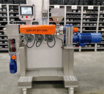
The EUR.EX.MA Filter Tester enables accurate and standard-compliant testing, reproducing realistic processing conditions at laboratory scale, even with limited material quantities.
The system integrates a single-screw extruder, a gear melt pump and high-precision pressure sensors, combined with easily replaceable standardized filters. During the test, the software automatically records the FPV value and displays the pressure trend, allowing immediate comparison between different materials and quick identification of potential issues.
High repeatability and strong correlation with real processing behavior make it an effective tool for both R&D and quality control activities.
WHERE THE FILTER TEST MAKES A REAL DIFFERENCE
The Filter Test is widely applied in polymer processing, including masterbatch, filled compounds and recycled materials, both in development and quality control phases.
It enables objective comparison between materials, suppliers and batches, supports incoming quality control and helps optimize formulations.
Introducing an objective evaluation criterion allows companies to reduce variability and improve overall process reliability.
WANT TO ASSESS YOUR MATERIAL QUALITY?
Whether you need to compare suppliers, validate a formulation or identify the root cause of process defects, the Filter Test provides an objective parameter to rely on.
For more technical details, visit the dedicated page or contact us using the form below.